Our vision
See the life in the soil and care for soil microorganisms.Help us understand and nurture the soil, so we can farm and grow vegetables with greater confidence
SOIL FOOD WEB
What is the soil food web?
It is not a static “species list,” but a living network in which plant roots, bacteria, fungi, protozoa, nematodes, arthropods and earthworms continually exchange energy, nutrients and ecological functions.
Real soil is more than mineral particles
Soil consists of mineral particles, organic matter and living biological communities. Without organic matter and life, mineral particles struggle to form stable structure, and water and nutrients are more easily lost.
The rhizosphere is the most active part of the food web
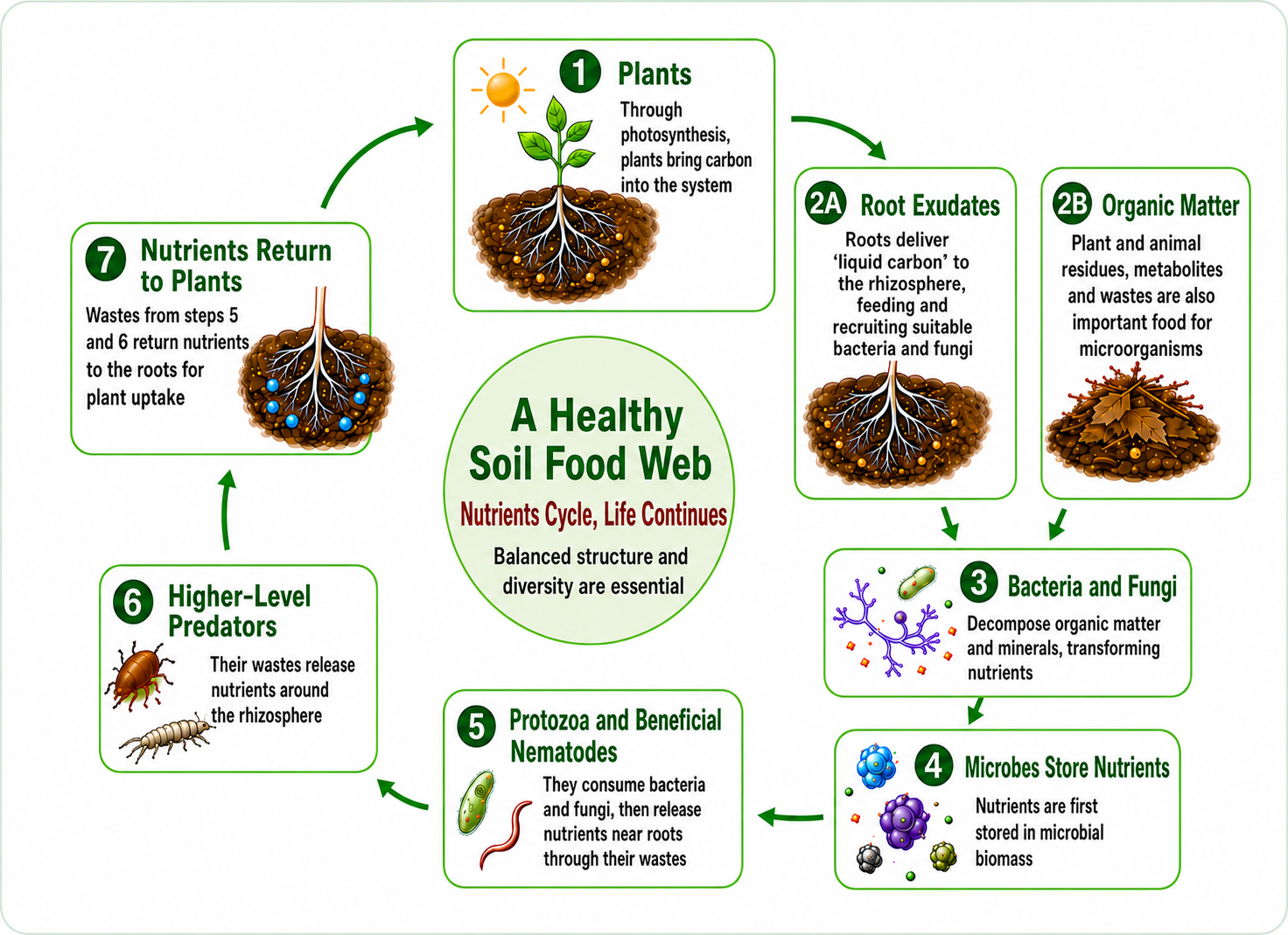
Plants send carbon below ground through root exudates and residues. Bacteria and fungi use this carbon to grow; protozoa, nematodes and other organisms then feed on them, converting nutrients into forms that plants can use more readily.
WHO IS IN THE WEB
Members and relationships
These organisms do not work independently. Through feeding, decomposition, symbiosis, competition and predation, they form a multilayered underground ecosystem.
How does the cycle work?
Plants send “liquid carbon” into the soil through root exudates, feeding bacteria and fungi in the rhizosphere. Organic matter in the soil is another important food source for them. As bacteria and fungi grow, they also help unlock nutrients bound in mineral particles through organic acids, enzymes and other metabolic activity. A substantial share of those nutrients is first stored temporarily in microbial bodies. Then protozoa, bacteria-feeding and fungi-feeding beneficial nematodes, and higher-level predators feed on these microbes and release surplus nutrients back near the roots through waste products and decomposition after death. When this cycle keeps running, nutrients are retained, transformed and reused instead of being easily lost, and the soil becomes more biologically active over time.
WHY IT MATTERS
What does a healthy soil food web do?
1
Supplies nutrients according to plant demand
Microorganisms first absorb and retain nutrients; predation then releases the surplus near roots.
2
Retains nutrients and reduces loss
Once nutrients are incorporated into organisms and organic structures, they are less likely to be lost through runoff or leaching.
3
Suppresses disease
Reduces pathogen pressure through competition for space and food, inhibitory metabolites, predation and parasitism.
4
Builds structure and improves water relations
Fungal hyphae, microbial glues, roots and soil animals jointly promote aggregates, pore space and deeper rooting.
5
Breaks down or stabilises harmful substances
Active aerobic communities can degrade some organic contaminants and bind certain elements within stable structures.
+
Makes the system more resilient
Diverse communities generally buffer changes in temperature, moisture and pest or disease pressure better than a single input.
The goal is not simply “more microorganisms”:Different plants require different food-web structures. Assessment should consider biomass, functional groups, aerobic conditions, plant type and management objectives together.
CURRENT STATUS
Current status: why many soils are closer to “dirt” than true soil
Elaine’s course repeatedly stresses that soil is not just mineral particles. Healthy soil is a living system built from minerals, organic matter, air, water, and a functioning biological community. In reality, many human-managed farm soils, vegetable beds, lawns, and park soils have been simplified by tillage, bare ground, compaction, waterlogging, salts, and biocidal inputs. As a result, they behave more like “dirt” — a degraded medium with weak structure, missing biology, and poor nutrient cycling.
🧱
Common symptoms
- Bacteria may still be present, but fungi, protozoa, and beneficial nematodes are often missing or far below what the plant community needs.
- Soil structure is weak, with limited pore space for air, water, and roots.
- The surface may crust, compact, pond water, or swing between hard-dry and sticky-wet conditions.
⚠️
Why soils slide toward dirt
- Repeated tillage, bare soil, and residue removal interrupt food sources and habitat for the food web.
- Excess salts, some pesticides, and anaerobic organic materials damage microbes, especially fungi.
- Compaction, chronic saturation, and a lack of living roots gradually reduce structure and biological diversity.
📉
What problems follow
- Greater dependence on fertilizers, pesticides, and irrigation, with lower resilience.
- More disease and pest pressure, shallow roots, lower flavor and nutrition, and greater vulnerability to extreme weather.
- Poor infiltration, more runoff and erosion, and declining long-term performance in fields, gardens, and parks.
| Setting | Typical unhealthy signs | What that often suggests |
|---|
| Farmland | Weedy patches, compaction, shallow roots, recurring pest and disease problems | Weak structure, low fungal presence, and a food web that no longer supplies enough function |
| Vegetable beds | Fertilizer is needed again and again, surfaces crust after watering, residues rot slowly or smell bad | Low organic matter, low aerobic biology, and sometimes anaerobic or salt-related stress |
| Parks and lawns | Shallow turf roots, yellowing, slow recovery, and worsening after foot traffic | Engineered or compacted soils that lack biology, structure, and self-repair capacity |
“Dirt” is a diagnostic word, not an insult: it tells us that the soil food web has not yet been rebuilt. Only when structure, oxygen, water, organic matter, and the right organisms recover together does the system begin to function again as living soil.
PEOPLE BEHIND THE SCIENCE
Who was Dr. Elaine Ingham?
Dr. Elaine Ingham (1952–2026) was an American soil microbiologist and an influential educator and practitioner in soil food web science. Across more than four decades of research and teaching, she helped turn complex microbial relationships into methods that people could observe, assess and apply.
From “what is in the soil?” to “how do they work together?”
Her central contribution was not simply to list bacteria, fungi, protozoa and nematodes, but to emphasize that feeding relationships, soil structure formation and nutrient cycling determine whether soil can truly support healthy plant growth.
Elaine founded Soil Foodweb Inc. and Soil Food Web School. She said: “Our mission is to empower individuals and organizations to regenerate the soils in their communities.”
Her main contributions
- Scientific research: long-term study of soil microbial communities, food web structure and plant growth.
- Soil food web framework: turning feeding relationships, nutrient release and structure formation into an observable and manageable ecological framework.
- Education: using courses, microscopy training and case studies to help more people understand soil life.
- Practical impact: her work has influenced farms, orchards, grasslands, landscapes and ecological restoration projects.
In one sentence
Healthy soil is not created by fertilizer alone; it depends on restoring a complete, aerobic and balanced community of soil organisms.
ASSESSMENT
How do we assess soil food web health?
A health assessment cannot rely on a single number. Field performance, soil physical condition, biological communities and plant responses must be interpreted together. The central question is whether soil organisms are complete, active, aerobic and able to provide the functions required by the target crop.
👀
Field observation
Examine ground cover, aggregates, odour, ponding, residue decomposition, rooting depth and pest or disease symptoms to establish a field baseline.
📏
Physical condition
Combine infiltration, soil compaction, root-restricting layers and water-holding observations to judge whether air, water and roots can move normally through the soil.
🔬
Biological community
Use microscopy or quantitative assessment to examine bacteria, fungi, protozoa, nematodes and other functional groups, and assess whether the community matches the target crop.
🌱
Plant response
Observe new roots, leaf colour, photosynthetic capacity, disease pressure, growth and quality. Plant performance is important evidence that soil functions are actually operating.
Assessment focus:A healthy soil food web should supply and retain nutrients according to plant demand, suppress disease, build structure and water-holding spaces, and participate in detoxification. Results should be compared with a baseline from the same field, a control area or repeated monitoring—not interpreted in isolation from the crop and environment.
| Assessment level | Suggested observations or tests | Question answered |
|---|
| Field level | Cover, odour, aggregates, roots, ponding and disease | Does the soil provide an environment in which aerobic organisms can work? |
| Physical level | Compaction, infiltration, root depth, water holding and drainage | Does structure restrict air, water or roots? |
| Biological level | Bacteria, fungi, protozoa, nematodes and functional groups | Are food-web members complete, and are their amounts and proportions suitable for the target crop? |
| Functional level | Leaf photosynthesis, growth, disease, quality and yield | Are soil biological functions being expressed in plant performance? |
IMPROVEMENT
How can soil food web health be improved?
The basic sequence is: diagnose first, reduce damage, improve habitat, inoculate missing beneficial microorganisms, help them establish, and then retest. In degraded soils with major functional groups missing after long-term chemical inputs or heavy disturbance, reducing tillage and adding organic matter alone are often insufficient;beneficial-microbe inoculation is one of the key steps in restoring the soil food web.。
🦠
Core step: inoculate beneficial microorganisms with BioComplete Compost
The core value of BioComplete Compost is not merely adding organic matter or a small amount of nutrients. It is to return verified aerobic bacteria, fungi, protozoa, beneficial nematodes and other functional groups to the soil. It should be understood as asource of diverse microbial inoculum,not ordinary compost or a single-strain product.
Identify what is missingUse microscopy and field diagnosis to determine which functional groups are absent and whether the bacterial–fungal structure suits the target crop.
Verify inoculum qualityBioComplete Compost should be mature, aerobic and free of putrid odours. Observation must confirm that it actually contains the required organisms, rather than relying on colour or product name.
Choose an appropriate application formSolid compost directly inoculates soil; compost extract is more suitable for soil drenches; and properly aerated compost tea can be used when actively growing microorganisms are required.
Help the inoculated community establishAfter inoculation, oxygen, moisture, living roots and a suitable food supply must all be present. If soil remains compacted, waterlogged, bare or exposed to biocidal inputs, inoculated organisms are unlikely to establish reliably.
| Inoculum form | Main use | Key requirements |
|---|
| Solid BioComplete Compost | Surface application, banding, planting-hole application or root-zone contact to introduce a complete biological community and organic matter directly into soil. | Mature, aerobic and quality-checked by microscopy; avoid immature, anaerobic or biologically incomplete material. |
| BioComplete Compost extract | Extracts microorganisms from compost surfaces into water, mainly for soil drenches, drip systems or large-area inoculation. | Do not add microbial foods during extraction; maintain aeration and agitation, and use promptly after preparation. |
| BioComplete Compost tea | Adds a measured food supply in water so target microorganisms actively grow; often used on foliage or in root-zone settings where rapid attachment is needed. | Food quantities must be tested, aeration must remain sufficient, and biological composition and activity should be checked before use. |
1
Assess and identify missing functions
Understand the existing structure of bacteria, fungi, protozoa and nematodes, then combine this with the target crop, field problems and management history to define the functions that need restoring rather than adding organisms blindly.
2
Reduce damage
Reduce unnecessary tillage, periods of bare soil and inputs that strongly affect non-target organisms, so newly restored hyphae, aggregates and predator networks are not repeatedly destroyed.
3
Improve air, moisture and structure
Address compaction, waterlogging or excessive dryness and create aerobic pore space. Even high-quality microorganisms cannot establish reliably when structure, moisture and oxygen are unsuitable.
4
Inoculate beneficial organisms from BioComplete Compost
According to assessment results, use verified BioComplete Compost, extract or tea to return missing aerobic functional groups to soil or foliage. This step rebuilds the soil food web; it is not merely “fertilisation.”
5
Maintain living roots, cover and an appropriate food supply
Use rotations, intercropping and cover crops to extend the period with living roots and maintain carbon inputs to the rhizosphere. Suitable organic materials can also support establishment and reproduction.
6
Verify establishment and function
Recheck organisms in soil or on foliage after inoculation, determine whether target functional groups have increased, and compare aggregates, roots, disease, photosynthesis and crop growth. Do not confuse “applied” with “effective.”
7
Continue monitoring and adapt locally
Retest in the same season and management stage, retain effective measures, adjust ineffective ones, and gradually develop an inoculation approach suited to local soil, climate, crops and application equipment.
Key reminder:BioComplete Compost is not ordinary mature organic fertiliser, nor a mixture of a few commercial strains. Inoculation can succeed only when the material truly contains the required aerobic functional groups and the receiving soil provides air, moisture, living roots and food. No single product, strain or one-time application can replace complete ecological management and subsequent verification.
LAB SERVICES
What can Soil Life Lab do?
The laboratory links field problems, biological observation, soil physical testing (compaction and infiltration), mineral-element analysis and plant responses to support teaching, farm trials and soil-vitality improvement.
🎓
Training
Provide training in soil-microorganism microscopy and BioComplete Compost, including inoculum production, maturity and aerobic-condition assessment, microscopic quality evaluation, and the basic use of solid compost, extracts and compost teas.
🔬
Soil food web health assessment
Assess major functional groups such as bacteria, fungi, protozoa and nematodes, and interpret them in relation to the target crop, management practices and field performance.
🪨
Soil mineral-element analysis
Measure major mineral elements such as potassium, calcium, iron, manganese, zinc and copper, together with selected risk elements, to understand the soil mineral nutrient reserve and its potential for nutrient self-supply. Results must be interpreted with pH, organic matter, the soil food web and plant-available nutrient tests, because total elemental content is not the same as immediate plant availability.
📐
Soil compaction testing
Use penetration resistance and related methods to identify root-restricting layers and compaction risk, interpreted together with moisture content, soil depth and root observations.
💧
Soil infiltration-rate testing
Use fixed-point infiltration tests to observe how quickly water enters the soil and help identify surface crusting, compaction, poor pore connectivity, ponding or runoff risk. Results must be interpreted with initial moisture, soil texture, test method and replicate measurements.
🍃
Plant leaf photosynthetic-capacity testing
Measure indicators related to leaf photosynthesis to help assess current plant vitality and management response; interpret results together with variety, leaf age, light, moisture and soil conditions.
1. Define the problemCrop, field and objective
2. Design samplingLocation, depth and controls
3. Test and observeBiology, physics (compaction and infiltration), minerals and plants
4. Interpret togetherIdentify the main limiting factors
5. Improve and retestCreate a verifiable plan
Service principle:Testing is not intended to label soil simply “good” or “bad.” It identifies constraints, establishes a baseline and uses retesting to determine whether management truly improves soil and plant functions. Mineral-element analysis indicates elemental reserves and risk signals; it does not replace plant-available nutrient testing or equal the amount a crop can use in the current season. Infiltration rate is affected by initial moisture, texture, surface condition and test method, so replicate measurements should be interpreted with compaction, soil structure and root observations.
IMPROVEMENT CASES
Three soil-restoration cases from Elaine’s course
These improvement cases show that rebuilding the soil food web is not limited to one crop or one climate. The same biological principles can be applied in farms, perennial systems, and urban ecological restoration. More case studies ↗
Farm · Banana
🍌
Shane Plath’s banana farm in South Africa
⏱ Clear recovery: about 2 years
The farm struggled with waterlogging, disease pressure, and a failing production system. After correcting anaerobic composting problems and rebuilding a complete aerobic biological system, beneficial fungi increased and plant condition improved visibly.
- Problem: waterlogging, anaerobic compost, and heavy disease pressure
- Approach: biologically complete aerobic compost and food-web restoration
- Time: conditions were poor in 2015; yields were recovering by 2017 — about 2 years
- Result: improved structure, healthier plants, and a more resilient system
Perennial crop · Vineyard
🍇
Botrytis suppression in a vineyard
⏱ Clear effect: about 2 weeks
In the vineyard example, fully biological compost tea was used to establish beneficial coverage on the leaf surface and was compared with a water-only treatment. Where the leaf surface was biologically occupied, Botrytis had far less opportunity to dominate.
- Problem: leaves were vulnerable under strong grey mold pressure
- Approach: increase beneficial microbial coverage on the leaf surface
- Time: about 2 weeks after application, the 70%–100% coverage areas showed no visible Botrytis
- Result: pathogen suppression, showing that the phyllosphere also matters
Urban ecology · Park
🏞️
Governors Island ecological rebuilding
⏱ Ecosystem restoration: about 1–2 years
This project began on construction debris and exposed substrate that was barely soil at all. By adding organic matter, building plant cover, and reintroducing the biological community, the site was gradually transformed into a functioning public landscape.
- Problem: almost no soil, no biology, and no structure
- Approach: rebuild habitat, reintroduce biology, and let structure develop
- Time: one correct biological application produced a quick visible difference; grass, shrubs, and trees established over about 1–2 years
- Result: a waste-based substrate became a public park with multiple ecosystems
The shared lesson: restoration does not start with “feeding fertilizer first.” It starts by reconnecting biology, structure, oxygen, water, and carbon inputs. Once the food web begins to recover, many nutrient, disease, and structure problems begin to loosen together.
ABOUT US
About us
Sichuan University Soil Life Research and Restoration Lab
Established in 2021. Core members include Dr Hongyan Lu, Dr Jiong Yan, Dr Xue Chen and Ms Wei Tang.
The laboratory promotes dialogue between field practice and science, helping farmers explore locally adapted pathways to rebuild soil vitality and strengthen agricultural climate resilience.
Professional qualifications: Dr Hongyan Lu holds two qualifications signed by Dr Elaine Ingham of the Soil Food Web School: (1) Soil Food Web Restoration Consultant; and (2) technical qualification to assess soil microbial health using microscopy.
SOURCES & LIMITS
Sources and limits of use
Soil food web foundations
- Soil Food Web School foundation courses and edited course notes.
- The site reorganises the core framework into plain-language explanations for public understanding and field use.
Sources for cover-crop selection
- 2-Cover_Crops_Technical_Guide.docx.
- Cover_Crop_Species_Database.xlsx, covering 91 species.
- Workbook_Cover_Crop_Selection.docx.
- USDA-ARS Cover Crop Chart V4.0 (April 2023).
- Supplementary references: FAO, SARE, USDA-NRCS PLANTS and the Midwest Cover Crops Council selector.
Soil food web health calculator
When the calculator is connected, indicator definitions, formulas, threshold versions and original methods will be listed here.
Important limit: weeds, plant symptoms and website recommendations are field clues and decision support, not substitutes for species identification, soil testing, microscopic biological assessment or local agronomic trials.